
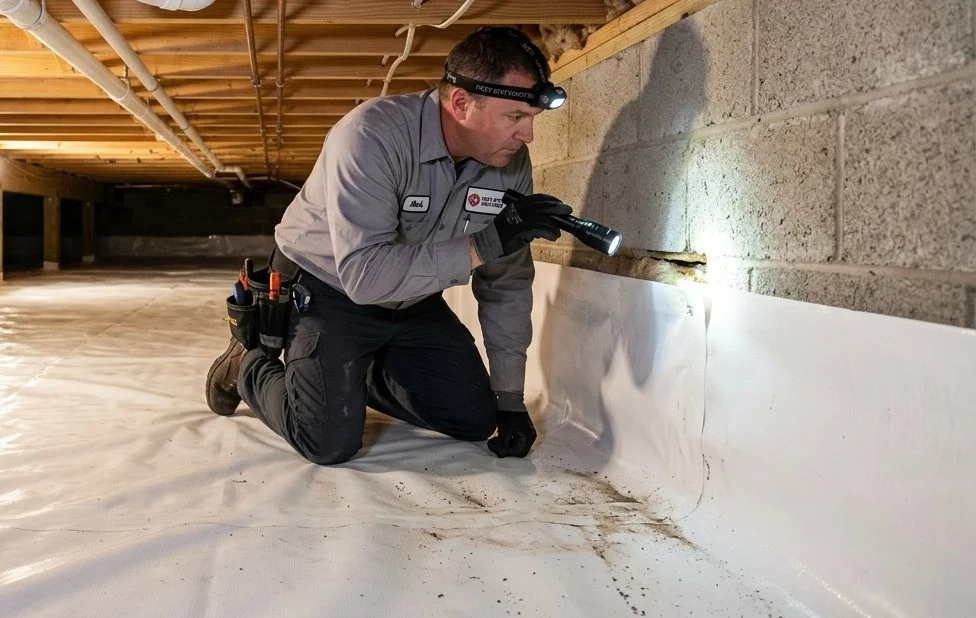
If you've had a pest control company treat a rodent problem before — traps, maybe some bait — and you're reading this because the problem came back, this post is probably for you.
Trapping and baiting are effective tools. They reduce the current population. But they don't close the entry points that allowed the population to build in the first place. Without exclusion — physically sealing the openings rodents are using — you are managing a symptom, not a problem.
What Is Rodent Exclusion?
Exclusion is the process of identifying and permanently sealing every opening in a structure that rodents are using or could use to enter. It's construction work, not pest control work — which is part of why many general pest control companies skip it or offer it only as an expensive add-on that most customers decline.
The work involves inspecting the full exterior — foundation, utility penetrations, crawl space vents, roofline, garage interfaces — and closing every gap above the minimum threshold: 1/4 inch for mice, 1/2 inch for rats. The materials used are ones rodents cannot chew through: hardware cloth, copper mesh, metal flashing, and silicone caulk over mesh (not foam alone).
Why Most Pest Control Skips It
Several reasons:
- It's labor-intensive. A full exterior exclusion inspection on a crawl space home with aging utility penetrations takes time and physical effort that a standard quarterly service route doesn't accommodate.
- Re-treatment is revenue. A customer who calls back six months after an infestation because the problem returned is another service call. Exclusion would prevent that call — but from a purely revenue perspective, that recurring call has value.
- It requires different skills. Exclusion work is more closely related to construction than to chemical application. Many pest control companies don't invest in the training, tools, or materials to do it properly.
None of this is a criticism of trapping or pest control generally — it's a description of a market gap. Exclusion is where most rodent programs are weakest.
What Happens Without Exclusion
The short version: the problem returns. The timeline varies by outdoor rodent pressure and how many entry points remain open, but the mechanics are predictable. You remove the current colony. The space they occupied becomes available. Pheromone signals — urine and gland secretions — mark the structure as a safe, established habitat. New rodents from the outdoor population enter through the same openings. You're back to a rodent problem within months.
In Henrico County, where outdoor rodent pressure is sustained year-round due to the county's wooded landscape and proximity to waterways, this cycle can be shorter than in lower-pressure environments.
What Proper Exclusion Involves
Here's what a thorough exclusion inspection and treatment covers:
- Full exterior perimeter walk — foundation, all penetrations, venting
- Crawl space or basement inspection — all vents, pipe entries, ground-to-structure interfaces
- Roofline inspection — gable vents, soffit-fascia interface, any roofline gaps
- Garage inspection — door weatherstripping, shared wall penetrations, pedestrian door gaps
- Documentation of all entry points before any closing
- Sealing with appropriate materials by location (mesh, hardware cloth, flashing, caulk)
We strongly recommend combining exclusion with any active-infestation treatment — see our exclusion service page for details. The cost ranges from $300 to $1,200 depending on the property. For most Henrico County homeowners who have had a rodent problem come back, the exclusion cost is less than the cost of repeated treatment visits over the next two years.
One Caveat: Timing Matters
If there is an active infestation, exclusion must be sequenced after or concurrent with population reduction — not before. Sealing a structure while a rodent colony is inside traps the colony, which creates a different problem (dead rodents in walls, secondary odor, potential secondary pest issues). We manage this sequencing and will advise on the right approach based on what we find during inspection.
Questions? Call us at (804) 606-1376, 5:00 AM – 11:00 PM ET, 7 days a week.
Ready to Get Rid of Rodents?
Call us now — we answer 7 days a week, 5:00 AM – 11:00 PM ET, 7 days a week. Describe the problem and we'll get someone to you as soon as possible.